Aesthetic Education in Chengdu: The “Let Aesthetic Education Develop Naturally on Campus” Themed Activity Successfully Held

In order to deeply implement the arrangements for aesthetic education on campus in the new era and the School Aesthetic Education Immersion initiative, perform the fundamental task of cultivating morality and nurturing talents, and continuously deepen the School Aesthetic Education Evaluation Reform, the “Chengdu School Aesthetic Education Evaluation Reform Topic Exchange Activity” themed ‘Let Aesthetic Education Develop Naturally on Campus’ was held at the Huiyuan Campus of Yucai Middle School Affiliated to Chengdu No. 7 High School on the morning of May 28. LI Mu, Tenured Professor and Ph.D. Supervisor of Tsinghua University and Director of the Aesthetic Education Experimental Center at Tsinghua (Qingdao) Academy of Arts and Science Innovation Research (TASA), GAO Dengke, Director of the Bachelor’s Committee of the Aesthetic Education Experimental Center at TASA, YU Miao, Deputy Director of the Aesthetic Education Experimental Center at TASA, and other experts were present at the event. Other participants included WANG Shanshan from the Sports, Health and Arts Department of Chengdu Municipal Education Bureau, and CHEN Yuyan, Deputy Director of the Education Reform Research Institute and Director of the Scientific Research Division of Chengdu Education Science Institute. Representatives of sub-project leaders of the city-wide aesthetic education evaluation reform project and over a hundred frontline teachers from various districts (cities) and counties gathered together to jointly explore new pathways and new ideas for aesthetic education and its evaluation.
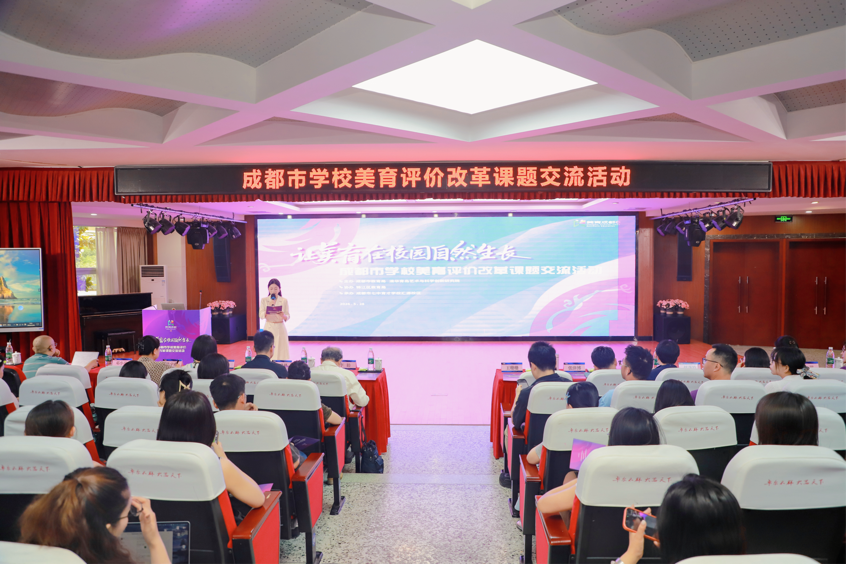
School Aesthetic Education Evaluation Reform Research Exchange in Chengdu
At the beginning of the event, WANG Shanshan from the Sports, Health and Arts Department of Chengdu Municipal Education Bureau outlined the origins of the research project and summarized its progress and achievements. In her heartfelt speech, she said: “Aesthetic education is not a subject that can be simply quantified through examinations; the value and importance of aesthetic education far surpass that of exam-oriented testing and deserve greater attention from the whole society.” She called upon aesthetic education practitioners to proactively shoulder the mission of nurturing students, take on the responsibility of aesthetic education, join hands with high-end scientific research platforms such as TASA to tackle challenges collaboratively, pool efforts to develop a scientific, diversified, student-centered, and practically implementable aesthetic education evaluation system that can be widely promoted, and thereby drive aesthetic education in Chengdu to truly advance into a new stage of professional and in-depth development. We should adhere to the philosophy of aesthetic education, allow natural growth, cultivate students through aesthetic education, and return to the original mission of education, so that campus aesthetic education can naturally flourish through aspiration in student cultivation.
GAO Dengke, Director of the Bachelor’s Committee of the Aesthetic Education Experimental Center at TASA, delivered a special report entitled Cultivating Students through Aesthetics and Promoting Teaching through Evaluation—A Survey on the School Aesthetic Education Evaluation Reform Project in Chengdu. At the meeting, on behalf of the project team, Mr. GAO delivered a research report with systematic elaboration on the core content, including the construction of aesthetic education evaluation indicators, the development of evaluation tools, and the advancement of regional pilot programs, covering both the theoretical framework and implementation. He said that after the themed activity concluded, the research team would also visit the First City Experimental School Chengdu in Wenjiang District and Anren Middle School in Dayi County, to continuously carry out aesthetic education research and subject study. He emphasized that the reform of aesthetic education evaluation should eliminate mechanical training, abandon standardized shaping, return to the educational essence of nourishing the soul and cultivating character, and thus allow aesthetic education to grow naturally in accordance with children’s nature. The description that “aesthetic education can be evaluated” is precisely the key lever that drives the quality improvement and upgrading of campus aesthetic education.
Representatives of the three subtopics made brief speeches respectively. YANG Jun, with Ba-Shu culture as the backdrop, shared research findings on the development and evaluation of interdisciplinary aesthetic education curriculum for middle school; WEN Xia focused on regional art academic quality evaluation, directly addressing current evaluation shortcomings; rooted in teachers’ professional growth, ZHAO Maozhu, explored the use of aesthetic education master teacher studios as a platform, and through approaches such as collaborative study and training, classroom refinement, and subject-based research learning, to help teachers enhance their aesthetic education competencies.
LI Mu, Tenured Professor and Ph.D. Supervisor of Tsinghua University and Director of the Aesthetic Education Experimental Center at TASA, delivered the closing remarks. He highly affirmed the value and fruitful achievements of this research project, saying he was deeply moved by the teachers’ solid efforts. He said that many front-line teachers have devoted years to aesthetic education practice, yet without the guidance of research projects and systematic study, their practice tends to become casual due to a lack of direction, making it difficult to generate broader influence and potentially leading to thinking solidification. Professor LI emphasized that the completion of a research project is more important than its inception. The key lies in thorough implementation and tangible results. The theme “Let Aesthetic Education Develop Naturally on Campus” is a distinctive concept unique to Chengdu. Only life can grow naturally, and staying true to its essence is the original aspiration of aesthetic education. Only when teachers continuously renew their educational philosophies can they effectively support the natural development of students’ aesthetic sensibilities. Against the background of aesthetic education in the new era, the courses, activities, and faculty of aesthetic education can all be reconceptualized, carrying vastly different connotations and values. Current education advocates a shift from “aesthetic education curriculum” to courses and subjects integrated into aesthetic education; an upgrade from “aesthetic education activities” to “activity-based aesthetic education” that deepens the essence of aesthetic education through practice; and an expansion from specialized “aesthetic education faculty” to the involvement of teachers across all disciplines, ensuring that aesthetic education becomes a shared responsibility integrated throughout the entire educational process.
This exchange event served both as a profound collision of ideas and a crucial opportunity for TASA to drive the deepening of aesthetic education evaluation reform in Chengdu. Moving forward, TASA will keep integrating resources across various domains. Leveraging evaluation as a guide, the classroom as the primary arena, and Bashu culture as the foundational context, TASA will continuously optimize the campus aesthetic education ecosystem, bring beauty beyond textbooks and into every corner of the campus, nurture children’s innate qualities and character through subtle aesthetic immersion, and strive to compose a new chapter in the natural and vigorous development of aesthetic education in Chengdu schools.