ZHAO Chao | Challenges and Solutions in the Deep Integration of Culture and Technology
Challenges and Solutions in the Deep Integration of Culture and Technology
Published in Theoretical Trends, an internal publication of the Party School of the CPC Central Committee (National Academy of Governance)
ZHAO Chao, Professor at Tsinghua University and Vice President of Tsinghua (Qingdao) Academy of Arts and Science Innovation Research
Promoting the deep integration of culture and technology has become a critical issue during the “15th Five-Year Plan” period, bearing on the building of China into a country with a strong culture, the cultivation of new quality productive forces, and the pursuit of the Digital China initiative. The integration of culture and technology refers to a composite development model wherein modern science and technology are deeply embedded throughout the entire chain of cultural creation, production, distribution, and consumption. It drives cultural transformation through technological innovation, while endowing technological innovation with value connotations through cultural development and transformation, thereby achieving organic integration and mutual empowerment. This involves not only utilizing emerging technologies such as artificial intelligence, big data, and the metaverse to transform and upgrade traditional cultural industries, but also deeply integrating humanistic spirit and cultural creativity into technological research, development, and application. However, as integration accelerates, some domains have experienced a structural imbalance characterized by “technology dominance and cultural weakening.” There is an urgent need to establish a synergistic mechanism in which culture guides technology and technology empowers culture.
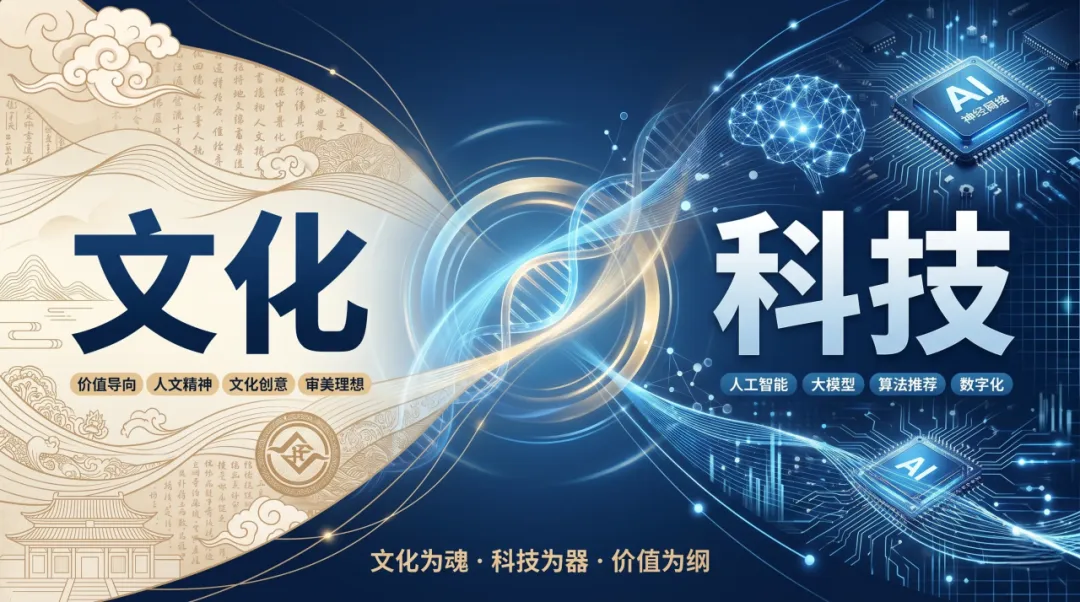
Deep integration of culture and technology
(Image generated by AI)
I.Evolution of the Times
From “One-Way Support” to “Two-Way Shaping”
At present, the rapid advancement of emerging technologies (represented by artificial intelligence generated content (AIGC), large language models, and algorithmic recommendation) is reshaping cultural production methods, dissemination mechanisms, and value expression systems. The relationship between culture and technology has evolved from a one-way support model of “technology serving culture” to a two-way interactive relationship in which “technology and culture” are mutually embedded and shaping each other. Emerging sectors such as digital content services, online audiovisual media, immersive experiences, and design services are becoming core growth drivers of the cultural industry.
1) Strategic positioning | Deep integration of culture and technology: General Secretary Xi Jinping stressed that we need to explore effective mechanisms for the integration of culture and technology, empower cultural development with digital and intelligent technologies, and shift to an IT-based development model. Against the backdrop of rapid technological advancement, the relationship between culture and technology has evolved from a one-way support model of “technology serving culture” to a two-way interactive relationship in which “technology and culture” are mutually embedded and shaping each other.
2) Theoretical core | Dialectical logic of two-way shaping: Culture and technology constitute a symbiotic system of mutual empowerment: technology provides cultural preservation tools and dissemination channels, while culture imbues technology with value orientation and ethical norms. They are not simply additive. Cultural production is transitioning from “human-led” to “human-machine collaborative,” yet “people-centered philosophy” remains the fundamental value orientation of integrated innovation.
3) Development history | From industry consensus to national strategy: China’s promotion of this integration has followed a clear trajectory from industry consensus to national strategy and comprehensive governance. This journey began with the articulation of “cultural technology innovation” in 2006, advanced with the elevation of cultural digitization to a national strategy in 2022, and gained further momentum through important instructions by President Xi Jinping during his inspection in Hunan in 2024. Most recently, the recommendations for the “15th Five-Year Plan” have embedded this integration within the broader framework of the Chinese path to modernization.
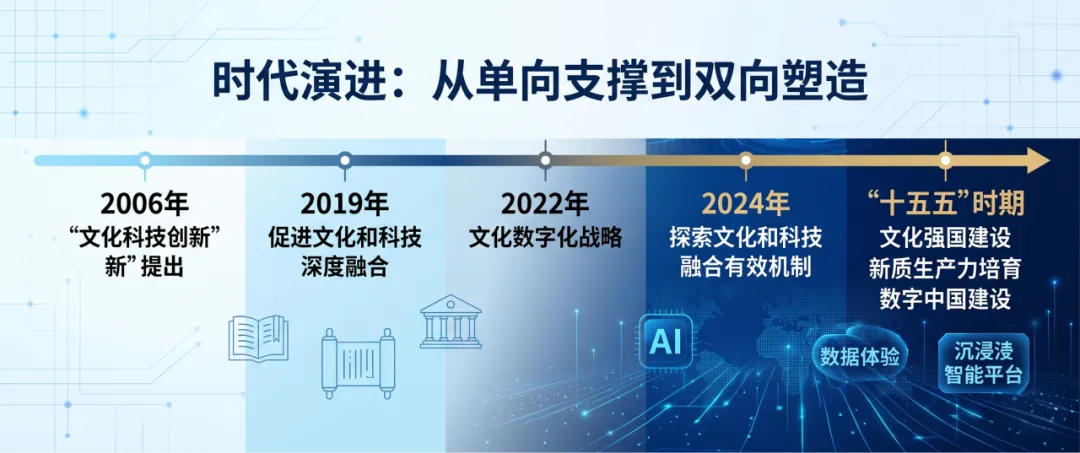
Timeline of time evolution
(Image generated by AI)

II. Realistic Dilemmas
“Five Imbalances” in Integrated Development
While notable progress has been achieved in the integration of culture and technology, a number of structural imbalances have also emerged. Of particular concern is that, with the advancement of artificial intelligence, value orientation is shifting from explicit expression to implicit embedding, increasingly manifested through algorithmic mechanisms, model architectures, and data selection. This makes the resulting issues more complex and much harder to detect.
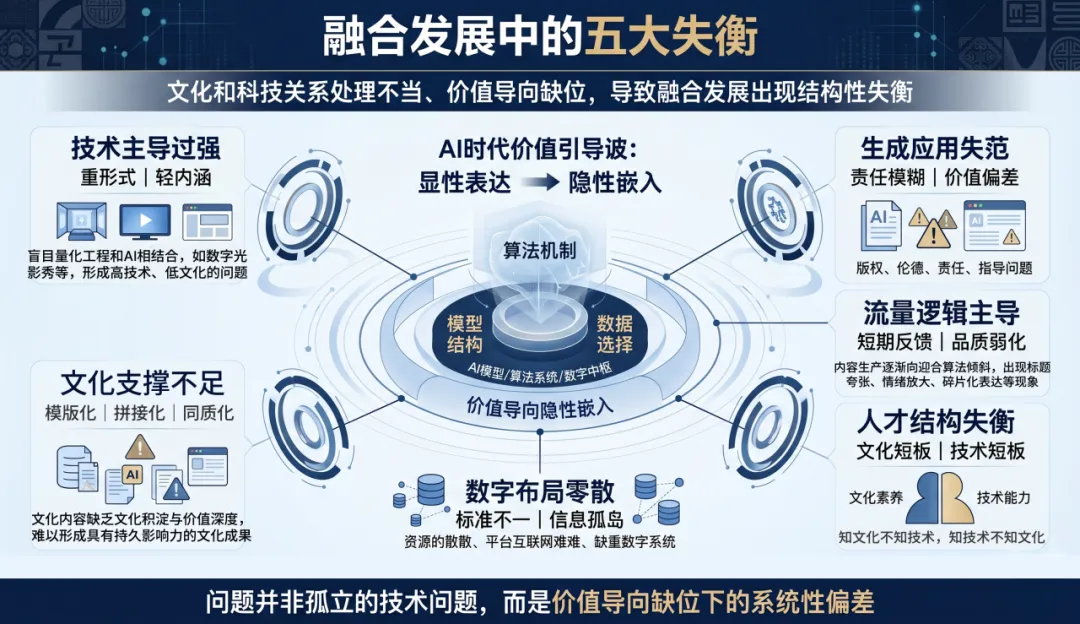
Five imbalances in integrated development
(Image generated by AI)
1) Excessive technology dominance with insufficient cultural content support: Some localities place excessive emphasis on platform construction and application scenarios while neglecting the in-depth exploration of cultural content, resulting in “a focus on form over substance.” In the context of cultural production involving AIGC, cultural products have also exhibited issues such as formulaic templates, collage-style combinations, and homogenized outcomes.
2) Unregulated generative applications and ambiguous value orientation: Generative technologies have significantly lowered the barriers to content creation, yet unclear value orientation and ill-defined accountability boundaries pose significant challenges. The copyright ownership, responsible entities, and ethical boundaries of AI-generated content have yet to be established. Once misinformation emerges, it spreads rapidly across wide areas and becomes extremely difficult to contain.
3) Weakened cultural quality and substance under the dominance of traffic-driven logic: Algorithms primarily prioritize click-through rates, repost volumes, and user engagement duration, leading content production to cater to algorithmic preferences and resulting in sensational headlines, emotionally charged presentations, and fragmented expression. High-quality cultural content, which requires time to mature, is consequently placed at a disadvantage in the competition for audience attention.
4) Fragmented digital deployment and poor coordination of resources: Some regions lack unified planning, resulting in redundant construction and scattered resources. Inconsistent cultural data standards across platforms hinder interconnectivity, creating “information silos” that constrain deeper integration.
5) Imbalanced talent structure and inadequate comprehensive competencies: There is a critical shortage of interdisciplinary talent proficient in both culture and technology. The prevailing phenomenon remains that “those with technical expertise lack cultural understanding, while those with cultural expertise lack technical proficiency.” In response, some leading international technology companies have begun to recruit substantial numbers of personnel with humanities and social sciences backgrounds.

III. Root Cause Analysis
“Two-Way Misalignment” of Culture and Technology
The aforementioned imbalances are not accidental but rather stem from deep-seated cognitive, institutional, and mechanistic factors. At their core lies a “two-way misalignment” between culture and technology, in which technological logic expands unilaterally while the guiding role of culture remains absent.
1) The myth of technological neutrality: The “technological determinism” neglects the mechanisms through which values are embedded in technology. In reality, technology is not value-neutral. Algorithmic logic, the composition of training data sources, and the boundaries of models are all shaped by the values and cultural backgrounds of their developers.
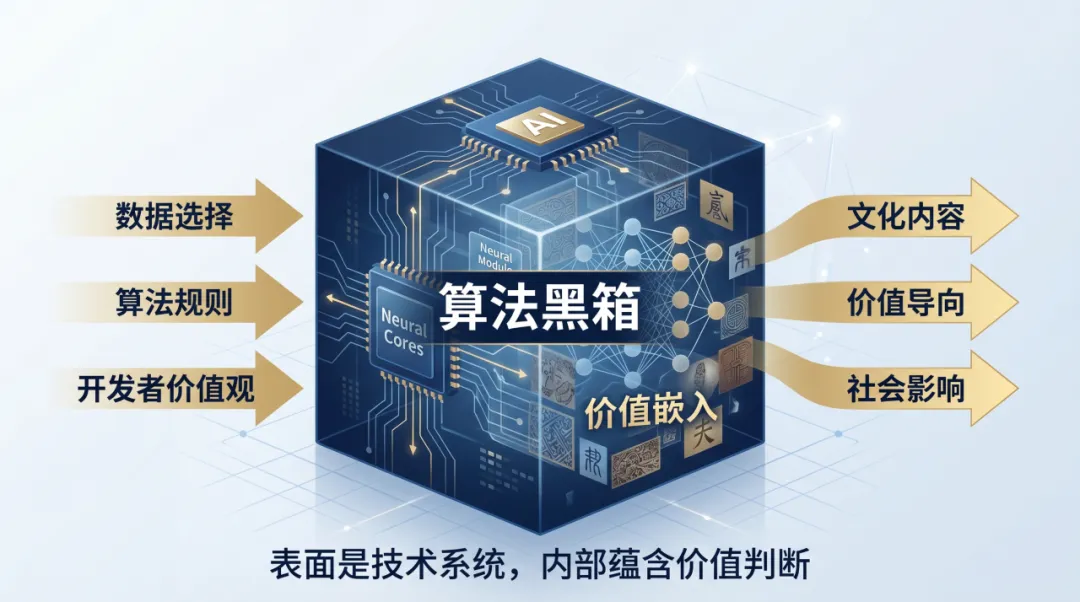
Technology is not value-neutral
(Image generated by AI)
2) The absence of cultural guidance: Culture often finds itself passively adapting to technology. For example, some short-video platforms offer a “one-click generate Chinese-style effects” feature that simplifies the complex meanings embedded in traditional patterns based purely on technical feasibility, without involving cultural scholars in the design process. In essence, this represents a colonization of cultural logic by technological logic.
3) Excessive dominance of traffic-driven logic: Platforms prioritize the maximization of user attention as their core objective, creating a “traffic-content” loop that increasingly homogenizes, sensationalizes, and fragments content, gradually giving rise to “information cocoons.” At a deeper level, traffic-driven logic is reshaping the aesthetic standards and power structures of cultural evaluation.
4) Lagging governance systems: Institutional revision cycles are lengthy, resulting in a passive situation of “technology first, regulation later.” Responsibilities remain unclear in areas such as copyright ownership of AI-generated content, identification of deepfakes, and accountability for algorithmic discrimination. Moreover, the governance rights and responsibilities of cultural, technological, and cybersecurity authorities often overlap or leave gaps.
5) Intensifying global competition: Developed countries have made this integration a strategic priority, actively cultivating cultural IPs with core competitiveness to seize the high ground. While the global digital cultural App has entered a bottleneck phase, AIGC is emerging as a disruptive opportunity. China urgently needs to forge a path of integration that differs from the Western paradigm of technological determinism.

IV. Governance Path
Building a Collaborative Mechanism Where Culture Guides Technology and Technology Empowers Culture
Addressing the value misalignment in the integration of culture and technology requires more than piecemeal solutions. What is needed is a systematic approach spanning cognitive, institutional, evaluative, and talent development dimensions to establish a governance system characterized by two-way synergy and mutually reinforcing interaction between culture and technology.
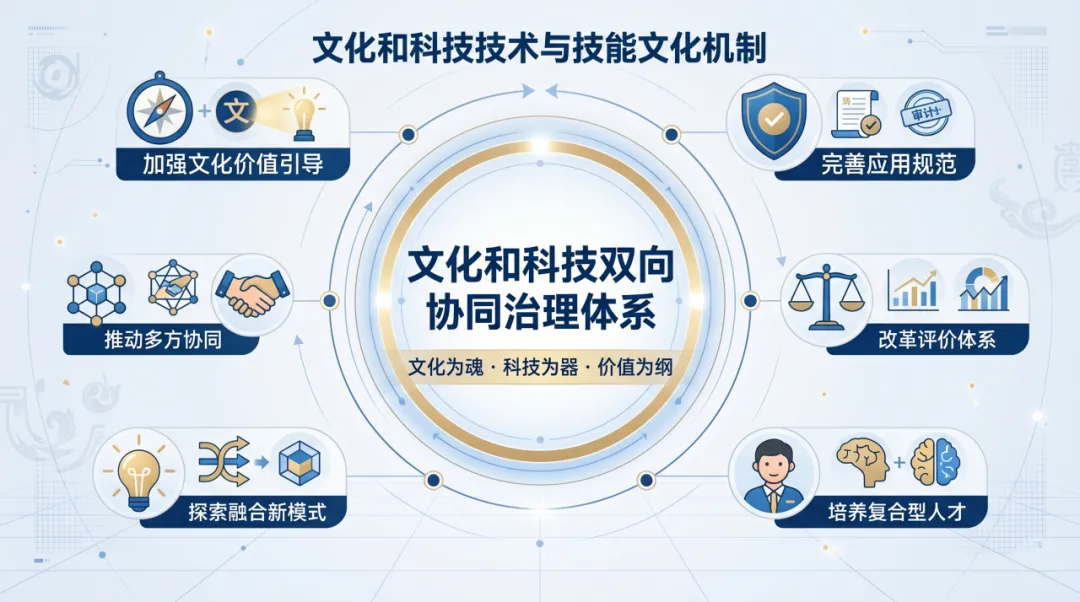
A collaborative mechanism where culture guides technology and technology empowers culture
(Image generated by AI)
1) Strengthening cultural value guidance: Cultural value orientation should be embedded throughout the entire process of R&D, design, application, and evaluation. We should introduce cultural assessments at the algorithmic design stage, and establish calibration standards for training data. At the same time, we should encourage cultural institutions to take an active role in technological design, thereby changing the current pattern of “culture passively adapting to technology.”
2) Improving application regulations: A tiered and categorized content review system should be established, with stringent oversight for high-risk areas and room for innovation preserved in low-risk domains. We should define clear chains of responsibility for platforms, developers, and users, strengthen ethical review mechanisms, and enhance alignment with international rules.
3) Reforming the evaluation system: We should break away from the singular quantification logic by incorporating ideological depth, artistic quality, originality, and other cultural value indicators into algorithmic ranking. We should explore a “value‑weighted” mechanism, reinforce social benefit assessment, and promote algorithmic transparency to prevent “black‑box operations.”
4) Promoting multi‑stakeholder coordination: We should pursue stronger coordination at the national level, establish a unified cultural data standards system, develop a national cultural big data platform, and create a knowledge graph with distinctive Chinese cultural characteristics, thereby forming “a unified national network and a coordinated national plan” to break down “data silos.”
5) Cultivating interdisciplinary talent: We should reform the training system of colleges and universities by establishing interdisciplinary programs in “culture and technology” and developing emerging fields such as “Design + AI.” We should promote industry‑education integration, introduce an “industry mentor” system, and establish a “cultural technology special commissioner” system to strengthen grassroots talent support.
6) Exploring new models of integration: We should establish demonstration zones for integration in regions with rich cultural resources and a strong technological foundation, encourage cultural institutions, technology companies, and universities and research institutes to form innovation consortia. Emerging business forms such as immersive experiences, digital art, and intelligent audiovisual content should be nurtured as priorities.

The integration of culture and technology is an inevitable trend of the times. However, the key to successful integration lies not in technological stacking, but in value guidance. Only by upholding culture as the soul, technology as the instrument, and value as the guiding principle, and building a governance system of two‑way synergy and mutually beneficial interaction, can we avoid the deviation of “technology dominance and cultural weakening” and achieve truly high‑quality integration.